Давайте поговорим!

Зарегистрируйтесь, чтобы получить электронную книгу «Полное руководство по оборудованию для магазинов»

самые-полезные-советы-по-покупке-торгового-оборудования-в-Китае-pic

ТО, ЧТО ВЫ ДОЛЖНЫ ЗНАТЬ

How Many Checkout Counters Does a Grocery Store Need

How Many Checkout Counters Does a Grocery Store Need

You don’t want to have too few checkout counters because then you’ll have customers waiting in long lines during busy hours. You don’t want to have too many because then you’re wasting valuable floor space and increasing your equipment costs. So how many checkout counters does a grocery store actually need? It starts with your peak customer traffic.  Your store should have enough checkout counters to handle the number of transactions you do during your busiest hour without making people wait in line too long. Start by dividing the number of transactions you do during your busiest hour by the number of transactions one counter can do in an hour. Then add some extra capacity for when you have a big rush, when your equipment goes down, and when you change your staffing. The size of your store is a factor, but the number of people you have and how fast you can check them out are the more important factors to consider. Let’s talk about how you figure that out and what you should think about before you buy grocery store checkout counters.  How Many Checkout Counters Does a Grocery Store Need How Do You Calculate How Many Checkout Counters You Need? I suggest you start with your busiest time, not your average daily volume.  A simple planning formula is: Required checkout counters ≈ Peak-hour transactions ÷ Transactions per counter per hour Let’s say your supermarket does 120 transactions during its busiest hour.  If your own numbers show that

Продолжить чтение »
Корзина покупок Home Depot на складе

What Type of Shopping Carts Does Home Depot Use

If you own a retail store, you may have noticed how durable Home Depot shopping carts are and wondered what kind they use. Choosing the wrong cart can mean constant repairs and unhappy customers. So, knowing the kind used in a high-traffic retailer like Home Depot can be helpful.  Home Depot primarily uses heavy-duty commercial shopping carts designed for frequent use in a large retail environment. Regular carts usually have a metal basket, four-wheel design, child-seat area, and a strong frame for carrying everyday purchases. Home Depot stores may also offer specialized carts for oversized merchandise, but the familiar basket-style shopping cart is still an important choice for customers purchasing smaller items. For retail store owners and shopping cart purchasers, the more important question is what makes this style of commercial cart good for demanding everyday use.  What Kind of Shopping Carts Does Home Depot Have? The most common choice is the regular basket-style shopping cart. It looks like a grocery cart but is designed to work in a home improvement retail environment where customers might buy heavier or bulkier items.  A typical commercial design combines a wire basket with a sturdy lower frame and four wheels. The open-wire construction keeps the basket relatively light while allowing customers and store employees to see what’s inside.  Home Depot also has specialized material handling carts for big building supplies. However, if you’re looking for a Home Depot shopping cart as a model for your own retail business, the regular metal basket cart

Продолжить чтение »
Деревянные и стальные кассовые стойки для Woolworths

Store Fixture RFQ Guide

Getting a store fixture quote that’s accurate shouldn’t require endless emails. But if you send incomplete information, you’ll leave vendors guessing about materials, dimensions, quantities, or delivery requirements. That can mean revised prices and lost time. So, let’s make it easy for you to get a store fixture quote.  To get an accurate quote for a store fixture, you need to include the product type, the dimensions, drawings, the materials you want the fixture made from, the finishes you want, the quantities you need, any load requirements, any customization details, your target timeline, where you want it delivered, and how you want it packaged. For products like retail shelving, shopping carts, shopping baskets, checkout counters, and warehouse racking, you also need to provide product-specific specifications so manufacturers can quote you accurately. The specifics you need to include depend on what you’re buying. For example, if you’re buying shelving, you need different technical details than if you’re buying a shopping cart or a checkout counter.  What Information Should Be Included in a Store Fixture RFQ? When we get an RFQ, the first thing we need to do is understand exactly what you want us to make.  A useful RFQ package generally includes: Product type and intended application Drawings or reference images Dimensions Materials Colors and finishes Load requirements where applicable Quantity Customization requirements Quality and compliance requirements Prototype or sample requirements Target production schedule Delivery date and destination Packaging requirements Shipping responsibilities The more specific you can be, the fewer assumptions

Продолжить чтение »
Схема настенных полок Action Shop

How Many Gondola Shelving Units Does a Grocery Store Need

Ordering too much gondola shelving will waste your budget and valuable floor space. Ordering too little will leave you struggling to display your inventory. We find that the right quantity depends on four main factors: the size of your store, the layout of your floor, the dimensions of your aisles, and the size of each gondola shelving unit.  A grocery store doesn’t have one magic number for how many gondola shelves you need. It depends on how much usable sales-floor area you have, how you lay out your aisles, the length of the gondola runs, and the width of the sections. As a starting reference point, a convenience store might use somewhere between 30 and 60 sections. Larger grocery stores can use a whole lot more. The best way to figure it out is to design your floor plan first. Then divide the total length of gondola run you need by the width of each section. So, instead of just guessing based on square footage, we recommend you plan your aisles first. Here’s how to get a much better estimate.  How Do You Calculate How Many Gondola Shelving Units You Need? A simple starting formula is: Required gondola sections = Total planned gondola run length ÷ Width of one section Let’s say you have five center aisles, and each needs a 40-foot-long, double-sided gondola run.  Your total run length is: 5 × 40 feet = 200 linear feet If each gondola section is 4 feet wide: 200 ÷ 4 =

Продолжить чтение »
How to Calculate the Total Landed Cost of Store Fixtures

How to Calculate the Total Landed Cost of Store Fixtures in the USA?

A quote for shelves or a shopping cart can look great until it gets to the US. Freight, duties, tariffs, customs fees, and inland delivery can change the numbers quickly. If we only compare suppliers by unit price, we may miss the number that matters: total landed cost.  Total landed cost is the total cost of getting store fixtures from the supplier to where they’re supposed to be. A simple landed cost formula is: Product Cost + International Freight + Insurance + Customs Duties/Tariffs + Import Fees + Inland Transportation + Handling/Overhead = Total Landed Cost. For imported shelves and shopping carts, figuring these costs out before ordering gives retailers a better way to compare suppliers and plan budgets. So, how does this work when you’re actually ordering store fixtures? In the next few paragraphs, I’ll break down the math and show you what costs U.S. buyers need to consider.  What Is the Total Landed Cost of Store Fixtures? The total landed cost is more than what you see on a supplier’s quote.  For example, let’s say we at RedSheep give a retailer a quote on a shipment of store shelves or shopping carts. Depending on the agreed Incoterm, that product price might not include all the expenses it takes to move the fixtures through the supply chain and get them to the buyer’s final destination.  For an importer, the calculation may include: Product cost Export and international transportation Cargo insurance Customs duties and applicable tariffs Customs brokerage and import

Продолжить чтение »
Consolidate Shopping Carts And Gondola Shelving in One Shipment from China

How to Consolidate Different Store Fixtures in One Shipment?

Purchasing shopping carts, shelving, and baskets from China may seem like a good idea until you have to arrange three different shipments, deal with multiple handling, more paperwork, and wasted container space. I prefer to make it easy. I like to plan these supermarket fixtures together and consolidate them into one shipment whenever possible.  Yes, you can consolidate shopping carts, gondola shelving, shopping baskets, and other supermarket equipment into one shipment from China. The key is coordinating production schedules, verifying packing dimensions, bringing the products to one loading point, and creating a container-loading plan before you ship. Depending on your cargo volume, you can use FCL or LCL shipping. Good consolidation can improve container utilization and reduce unnecessary separate freight and handling costs. But consolidation is more than just putting different products inside the same container. We need to consider dimensions, weight, packaging, production schedules, and loading order before the cargo leaves the factory.  Can You Ship Shopping Carts, Gondola Shelving and Baskets in One Container? Yes. In many supermarket projects, you can ship these products together.  A new supermarket may need hundreds of shopping carts, several types of shopping baskets, and many sections of gondola shelving all at the same time. It’s not always the best solution to ship each product category separately.  The first thing I look at is the whole purchase list.  For example, a buyer may need: 180L shopping carts 60L rolling shopping baskets 25L hand baskets Double-sided gondola shelving Wall shelving End-cap shelving Checkout counters

Продолжить чтение »
How Wide Should Grocery Store Aisles Be

How Wide Should Grocery Store Aisles Be?

Figuring out how wide to make your supermarket aisles sounds easy until you start factoring in shelves, shopping carts, customer traffic, and accessibility. Make your aisles too narrow and your shoppers will feel crowded. Make them unnecessarily wide and you lose valuable merchandising space. So, how wide should you actually make your grocery store aisles?  As a practical planning benchmark, secondary grocery aisles are often about 5–6 ft (1.5–1.8 m) wide, while heavily trafficked main aisles might be around 8–10 ft (2.4–3.0 m) wide. The right supermarket aisle width depends on shopping-cart traffic, shelving depth, store size, accessibility requirements, and local building and fire codes. Always check the regulations that apply to your location before finalizing a layout.  These dimensions give us a starting point, but you need to put more thought into your supermarket layout. Here’s how I recommend you approach aisle planning.  How Wide Should Grocery Store Aisles Be How Wide Should Store Aisles Be? There isn’t one supermarket aisle width that works everywhere.  When I plan a grocery store layout, I think about the purpose of each aisle first. A secondary aisle with standard gondola shelving doesn’t have the same traffic requirements as a main aisle connecting produce, refrigerated sections, and checkout areas.  As a practical starting point: These are planning benchmarks, not universal legal requirements.  A busy supermarket might benefit from more generous spacing, while a smaller grocery store might need to optimize every square foot.  What Is the Standard Supermarket Aisle Width? There is no

Продолжить чтение »
what type of shopping carts does walmart use 1

What Type of Shopping Carts Does Walmart Use?

Shopping carts are one of the most important things in a store. They affect how easy it is for customers to shop, how quickly they can get through the store, and even how much they buy. For a store as big as Walmart, picking the right shopping cart is a big deal because millions of people use them every day.  Unlike warehouse clubs that focus on selling a lot of stuff at the same time, Walmart serves all kinds of different shoppers. Some people just run in for a few things, while others buy a whole week’s worth of groceries, household supplies, clothes, electronics, and stuff for the season. To help people who are shopping for different things, Walmart uses different types of carts instead of just having one kind.  So, what type of shopping carts does Walmart use? Walmart mostly uses medium to large metal shopping carts with seats for kids, strong wheels, and carts that stack inside each other. Some stores also have plastic shopping carts, little carts for quick trips, electric carts for people who can’t walk, and flat carts for big stuff. The types of carts different stores have depend on how big they are and where they are.  Why Does Walmart Use Different Types of Shopping Carts? Unlike warehouse stores like Costco or Sam’s Club, Walmart is set up to serve a lot of different kinds of shoppers.  One person might just run into Walmart to get some milk and bread, while another person might buy groceries,

Продолжить чтение »
Steel Thickness Guide for Gondola Shelving

Steel Thickness Guide for Gondola Shelving

When you’re picking out gondola shelving for your store, the thickness of the steel is one of the most important factors that will determine how strong the shelving is, how long it will last, and how much it will cost you. The best grocery store shelving is made with cold rolled steel, and the different parts of the shelving use different thicknesses of steel based on what they have to do to hold it all together. Picking the right thickness of steel will make sure your shelving safely holds your stuff and lasts a long time.  Struggling to Choose the Right Gondola Shelving? Not all gondola shelving is created equal. Two shelving systems may look the same, but the load capacity can be dramatically different based on the thickness of the steel and the material used. Understanding these differences will help you invest in shelving that will last you for years instead of having to replace it after a short period of time.  What Is Gondola Shelving? Gondola shelving is a modular retail display system found in grocery stores, convenience stores, drug stores, hardware stores, and specialty retailers. A complete gondola unit includes:  Uprights Base legs Base shelf Adjustable shelves Shelf brackets Back panels (solid, perforated, or slatwall) Top covers and accessories The modular design of gondola shelving lets you change the height of the shelves and the way they’re set up as the products you sell change.  Why Steel Thickness Matters Steel thickness directly influences: Load capacity Structural stability

Продолжить чтение »
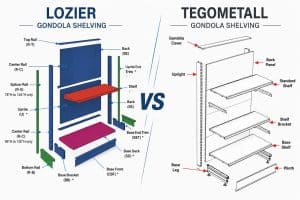
Lozier vs Tegometall Gondola Shelving

Difference Between Lozier and Tegometall Shelving

If you’re opening a retail store or upgrading your existing fixtures, choosing the right gondola shelving is one of the most important decisions you’ll make. Your shelving affects everything from how your products look and how your customers feel to how you organize your inventory and how much it costs you to operate your store in the long run.  Two of the most recognized names in retail shelving are Lozier and Tegometall shelving. Both companies make durable gondola shelving systems used by retailers all over the world, but they serve different markets and follow different design standards.  For American shop owners, the choice isn’t always as straightforward as it seems. While Lozier gondola shelving is the industry standard in North America, Tegometall shop shelving has become an increasingly popular alternative because it’s cheaper and works just as well.  Lozier and Tegometall are both high-quality retail shelving systems, but they are designed for different markets and are generally not compatible with each other. Lozier shelving is the most popular gondola shelving brand in North America, while Tegometall is used throughout Europe and many international markets. Both systems are extremely durable and can hold up to 200 kg (440 lbs) per shelf, depending on how you set them up. For U.S. retailers, the decision usually comes down to budget, compatibility, and how easy it is to find replacement parts.  Whether you run a convenience store, supermarket, liquor store, pharmacy, hardware store, or specialty retail shop, knowing the differences between Lozier and Tegometall shelving will help you

Продолжить чтение »
Шон Ву, фотография головы

Получите эксклюзивную электронную книгу

Узнайте, как правильно покупать торговое оборудование. Этими знаниями я делюсь только с подписчиками моей закрытой рассылки.

У Шона невероятные познания в области обустройства магазинов. Если вам нужны навыки более высокого уровня, вам стоит почитать его материалы.
Фотография головы Лучиана Попы
Лучиан Попа
Менеджер по развитию бизнеса в Lucky Store Solution SRL

ПОПУЛЯРНЫЕ СТАТЬИ